
Actual inventory
Check the available quantity in each silo or tank, including at another site.
WEIGHING TANKS, SILOS AND HOPPERS
Silo Monitor combines Neutron weighing with cloud monitoring in Scale Monitor. Monitor weight, consumption and alarms from any location.


Explore equipment, variants and current prices in our online shop.
WHEN AN INVENTORY ESTIMATE IS NOT ENOUGH
Manual readings, silo inspections and scattered records quickly become outdated. Purchasing relies on estimates, production discovers shortages too late, and increased consumption can go unnoticed. Silo Monitor connects material weight with inventory visibility in Scale Monitor Cloud, giving production, purchasing and management one shared overview.

Check the available quantity in each silo or tank, including at another site.
Track inventory movements, filling and emptying. Compare periods and identify unusual changes.
Set a lower inventory threshold and alerts by email, SMS or dashboard, according to your configuration.
CONSUMPTION MONITORING IN PRACTICE
Current weight shows how much material is available. History shows how fast you use it: consumption per day, week or month, delivery dates and increases in usage. This helps you align order quantities, lead times and safety stock.

Compare periods and relate consumption to production output. If a similar amount of finished goods requires more material, you have a starting point for checking the process, scrap or losses.
With 12,000 kg in stock and consumption of about 2,000 kg per day, you have material for approximately six days. With a four-day delivery lead time, plan your order early enough and allow for a safety reserve.
Opening inventory + material added − closing inventory gives consumption for the period, accounting for other movements. Comparing this with your records helps identify differences to investigate.
WHERE SAVINGS COME FROM

Earlier alerts help you plan regular deliveries, reducing the risk of express transport, last-minute orders and production waiting for material.
Plan deliveries using actual availability and consumption. More appropriate safety stock can release working capital and reduce inventory financing costs.
Remote visibility reduces inspections and retyping. An unusual weight drop prompts checks for leakage, uncontrolled withdrawals or process deviations.
Time is a cost too: reducing manual checks by 15 minutes per working day over 22 working days saves 5.5 hours per month. Reducing inventory value releases capital; annual savings primarily relate to lower financing and inventory management costs.
LOCAL CONTROL · REMOTE MONITORING
Neutron NS and Neutron NT can independently control silo filling and emptying, with inputs, outputs and connected equipment configured for your process. If you already use a PLC or SCADA system, we enable simultaneous operation with your existing control system. Scale Monitor adds remote inventory monitoring, history and diagnostics.
PLC and SCADA integration →Tank or silo weight
Weighing and local connectivity
ONE NEUTRON · MULTIPLE SILOS

NEW INSTALLATION OR UPGRADE

For control cabinets, OEM applications and systems without a local display.
Buy Neutron NS →For the operator at the device, local settings and diagnostics.
Buy Neutron NT →COMPLETE WEIGHING SYSTEM
We can supply the system with load cells from different manufacturers, with capacities from 40 to 400,000 kg. We match the selection to the tank, silo or hopper, number of supports, loads and operating conditions.
We select the capacity and design to suit your installation requirements.
Load cells and prices →We combine the kit with Neutron NS or NT for weighing and data connectivity.
Smart silo weighing kit with four CPX load cells and a Neutron NT terminal.
View the CPX kitTECHNICAL OVERVIEW
| Supply | Complete system with a set of load cells |
|---|---|
| Load cell capacities | From 40 to 400,000 kg, depending on the model |
| Load cell selection | Different models and manufacturers to suit the application |
| Weighing channels | Up to 4 independent channels |
| Channel settings | Calibration, logging interval, alarm thresholds, hysteresis |
| Neutron NS | Compact design without a display for control cabinets |
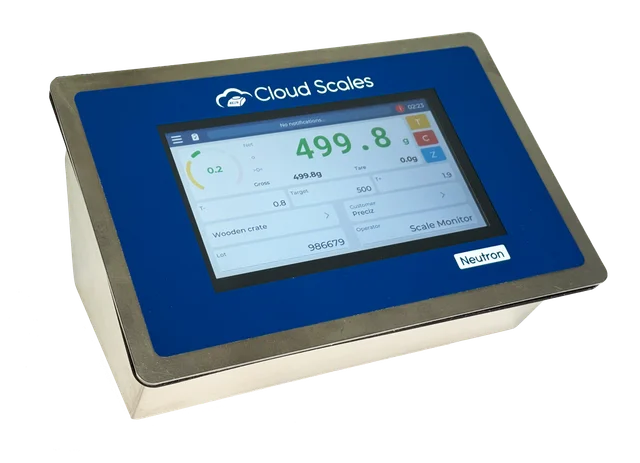
| Neutron NT | Local display on a 7-inch touchscreen |
| Industrial communication | Modbus RTU/TCP, RS-232/485, TCP/IP, WebSocket, MQTT/MQTTS |
| Network | Wi-Fi, Ethernet or optional LTE/SIM for an autonomous mobile connection |
| Digital signals | 6 inputs and 6 outputs |
Interfaces and design depend on the project configuration.
Silo Monitor brochure (EN)NEUTRON NS / NT · AI PREDICTIVE MONITORING
A scale can start to drift before the operator notices a problem. With Neutron NS or NT, you can monitor individual load-cell signals and take action in time.
Reduce the risk of downtimePlan service before wear causes the process to stop.
Reduce material lossesDetect changes in measurement before they affect dosing or consumption.
Protect product qualityReduce the risk of nonconforming batches, complaints and rework.
Neutron NS and NT use integrated AI to monitor the measurement signal and its drift. They can predict the need for inspection, recalibration or replacement of an individual load cell before it fails.
FROM SIGNAL TO TIMELY ACTION
| Load cell | Status |
|---|---|
| 1 | Stable |
| 2 | Stable |
| 3 | Stable |
| 4 | Stable |
Measured signalTrend forecast
Illustration of predictive monitoring, without actual measurement data.
DATA IN YOUR BUSINESS SYSTEM
Through Scale Monitor Cloud, Silo Monitor can be integrated with your ERP, MES, WMS or another business application. Silo data becomes available where you plan orders, manage production and track materials.
Your business system retrieves available measurement and inventory data when needed. Use it for reports, material planning and comparisons between actual consumption and your records.
Data or an event can be sent to an agreed endpoint in your system. This can trigger a purchasing notification or a workflow, for example when inventory reaches a threshold, according to the agreed integration.
Connect actual inventory with production plans, track consumption and prepare a purchase proposal in your existing system. Your team uses the data without manually transferring it between applications.
We agree the data, events, transfer frequency and access permissions with your IT team or business system provider. The integration is tailored to the available interfaces and your process.
LET US PLAN YOUR PROJECT
Tell us about the material, vessel volume and weight, number of supports and operating conditions. Include photographs, required accuracy and existing equipment details.
Send an enquiryEQUIPMENT IN OUR ONLINE SHOP
Kit with four CPX load cells and Neutron NT for a new installation.
Buy a silo weighing kitCompact weighing electronics for connecting load cells and upgrading your system.
Buy Neutron NSWeighing terminal with a 7-inch screen for local operation and cloud connectivity.
Buy Neutron NTFREQUENTLY ASKED QUESTIONS
Neutron NS and Neutron NT predictively monitor the signal and drift of every individual load cell. They use the trend to predict the need for scale recalibration and identify the risk of future cell failure, allowing checks and replacement to be planned in time.
Yes. We can supply the system with load cells from different manufacturers, with capacities from 40 to 400,000 kg. We select the design and capacity to suit the installation and loads.
Yes. Neutron NS and Neutron NT work with load cells from all manufacturers. We adapt the connection and interface to the existing installation, bringing tanks, silos and weighing systems with installed load cells into Scale Monitor Cloud.
Up to four independent weighing channels, each with its own settings.
Yes. Local control and cloud monitoring can operate at the same time.
Authorised users can access the data through a web browser on a computer, tablet or phone.
It sets the offset for resetting an alarm and reduces repeated alerts when the value fluctuates near the threshold.
Send us the number of vessels, maximum weight, photographs of the supports, existing load cell specifications, and your control and connectivity requirements.
START WITH YOUR PROCESS
Tell us about your project.
Let's define the next step together.